
Michelle Hollands, CEO of Hockey New Zealand
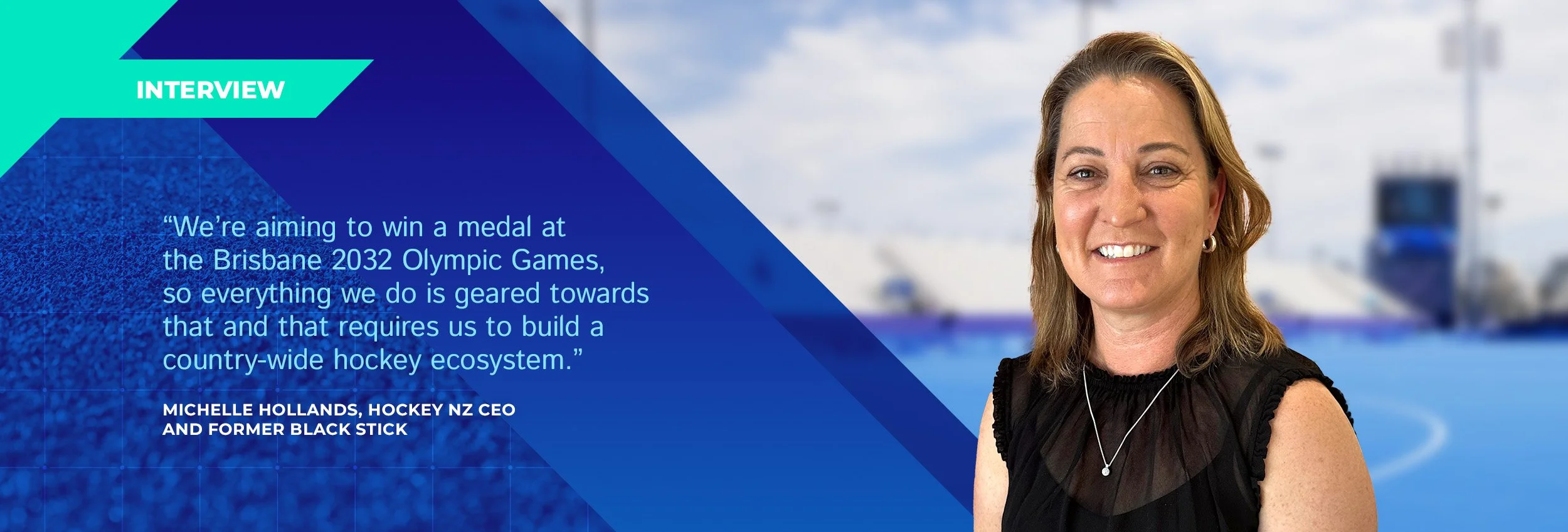
The former Black Stick talks World Cup and Olympic ambition and having hockey in your blood.
Michelle Hollands brings a lifelong love of hockey to her new role as CEO of Hockey New Zealand. The former Black Stick – with 99 caps and years of leadership experience across sport and business – understands the game from every angle, from local fields to hockey’s biggest stages. As she helps shape the next chapter for hockey in Aotearoa, it’s all about people, pathways, and podiums.
How did you start your life in hockey?
My mum was the Secretary of the New Zealand Women's Hockey Association, so I started as a four-year-old with a sawn-off hockey stick because that's what you did back then. To this day, I can remember the smell of the oil that they use to mark the fields. I've played for four associations in New Zealand over my career and made 99 appearances for New Zealand across the Commonwealth Games, World Cups and the Olympics.
“We are truly a hockey-for-life environment in New Zealand.”
Tell us about what’s happening at Hockey New Zealand?
We’re aiming to win a medal at the Brisbane 2032 Olympic Games, so everything we do is geared towards that and that requires us to build a country-wide hockey ecosystem. To that end, we’ve decentralised our high-performance programmes, sending them back across the country to train at home in order to expand the surrounding pools of players, increase the quality competition and grow our regional environments. It's all about helping our Black Sticks stand on the podium in 2032.
You’ve been the CEO for a few months now. How's it going?
It’s great. We have a really good team of people working inside Hockey New Zealand and the hockey community is doing a good job of building the system. The biggest challenge we've got is probably the same for every single sport – the dollars and cents. We’re trying to balance our ambitions with the money we actually have. So, a big part of my role is growing our revenue around a wider range of commercial, philanthropic and other interests.
Tell us about the New Zealand hockey scene at the moment.
Hockey in New Zealand is largely driven by our young people, who start playing at school and then might play both school and club hockey as they get older. And from there, there’s a pathway into the rep sides around U16, U18, our national competition and then our Premier League, which is part of our high-performance program.
That said, we have a massively strong Masters competition. We recently had over 600 athletes trialling for our New Zealand teams to head to the 2026 World Masters Hockey in Europe next year. We are truly a hockey-for-life environment in New Zealand.
Why do you think Masters hockey is so big in New Zealand?
If hockey's in your blood, it's in your blood for life. We had two ladies here recently for the trials, one living in Marlborough and one living in Auckland and they would never have met each other if it wasn't for hockey. They’re great friends off the field, but on the field they’re trying to take each other out! The game might look a little slower as you get older but it's still all about skill, tactics, fitness, and aggression.
Why is the Premier League, which is underway now, so important for New Zealand hockey?
The Premier League is the cornerstone of our high-performance environment. The drive is to create quality competition environments for our top players and the ones pushing to be Black Sticks so that they are internationally ready and competitive when we head to the next World Cup and the Olympics.
The Premier League gives our best players the chance to compete on the best surfaces, like the Poligras Paris GT zero at Lloyd Elsmore, the Poligras Platinum at Nunweek Park, and Poligras Tokyo GT zero at Wellington’s National Hockey Stadium.
What’s next for the Black Sticks?
Next year is the 50-year anniversary of our 1976 Men’s team winning gold at the Montreal Olympics, so it's a big year for us celebrating our history. But in terms of planning for our future and heading to the 2026 World Cup, we'll host international matches here.
We've got five women's teams and four men's teams coming out for a summer series as preparation, and then we've got our Indian Centenary, which is part of a broader sport movement to celebrate 100 years of our sports partnership with India. So for us, the World Cup is definitely a piece of the puzzle, as we want both our teams in the top eight, hopefully the top six. And of course there’s the pathway to LA28 and Brisbane 2032, and our goal of getting on the podium again. There’s always work to do, even when celebrating.
What’s the significance of the Centenary event?
It commemorates the first Indian hockey tour of New Zealand in 1926. During that tour, the Indian team (which travelled as the Indian Army team) played 21 matches, including three games against the New Zealand national team. These fixtures hold great historical significance, as they were the first international matches ever played by the Indian hockey team.
The 1926 squad went on to form the core of the extraordinary Indian team that later dominated the sport, winning Olympic gold in 1928, 1932, and 1936.
The centenary marks a celebration, but also the importance of the ties between our countries and acknowledging the economic value of sport for both of us. We're looking to strengthen diplomatic relations and create commercial partnerships and relationships with, through and beyond sport. As a country, we recognise that India is a really important part of our future, and this sporting anniversary is a special one.